
Iowa County Wanted List Status
Iowa County has no general most wanted page. The Iowa County Sheriff’s Office site covers agency contacts and jail services, nothing more. There is no wanted gallery, no list of people with active warrants, and no posting schedule, photo policy, reward program, or web tip form tied to a county list. That also means no listing count exists to cite.
An empty web search proves nothing either way. Some warrant details stay sealed until served. Police databases are closed to the public, and an old social media post can linger long after a case moves on. The only answer that counts comes from the responsible office itself.
Iowa County Wanted Record Fields
With no public general list in Iowa County, promising that a county listing shows a portrait, a charge, a description, or a last known location would be false. Some fields can be confirmed directly. Others must be checked with a different office. The table draws that line clearly.
| Field | Verified treatment |
|---|---|
| Name and photograph | No county general list; the specialist state registry may show these within its limited scope. |
| Warrant basis | Dispatch or court may confirm what is public; unserved matters can be restricted. |
| Charge or case | Public court cases may show charges and an identifier after becoming searchable. |
| Last known area | No standard county online field was verified. |
| Case outcome | The later court docket, not a wanted notice, shows disposition. |
Disposition is the result a court records, such as dismissal, plea, or judgment. It may differ from the initial charge filed.
Read an Iowa Wanted Notice
One statewide specialist page stands out. It is the only verified wanted resource with photos that filters by county. It does not cover every Iowa County warrant. Check the source and date before acting on it.
- Confirm the page belongs to a government agency and Iowa County means Iowa County, Iowa.
- Read the scope. A registry absconder list is not the Sheriff’s full warrant list.
- Check the notice date and named agency; do not assume an old post is current.
- If the person is seen, move to safety and contact law enforcement. Never confront or post a live location.
- Use Iowa County booking and court sources to distinguish custody, charges, and outcomes.
A later jail booking can signal that an arrest happened, but Iowa County publishes no public roster. For custody questions, call the Jail Division. Then follow the court docket to trace where the case went.
Iowa Registry Most Wanted Scope
The Iowa Sex Offender Registry most-wanted interface is an official statewide tool for registrants flagged as absconding or noncompliant. It filters by county and carries a warning against trying to apprehend anyone. Keep its scope straight, though. This is not the Sheriff’s general wanted list, and a person missing from it may still have other warrants.
The interface appears here because it fits this narrow subject. It is a live government source view, not a copied gallery of faces.
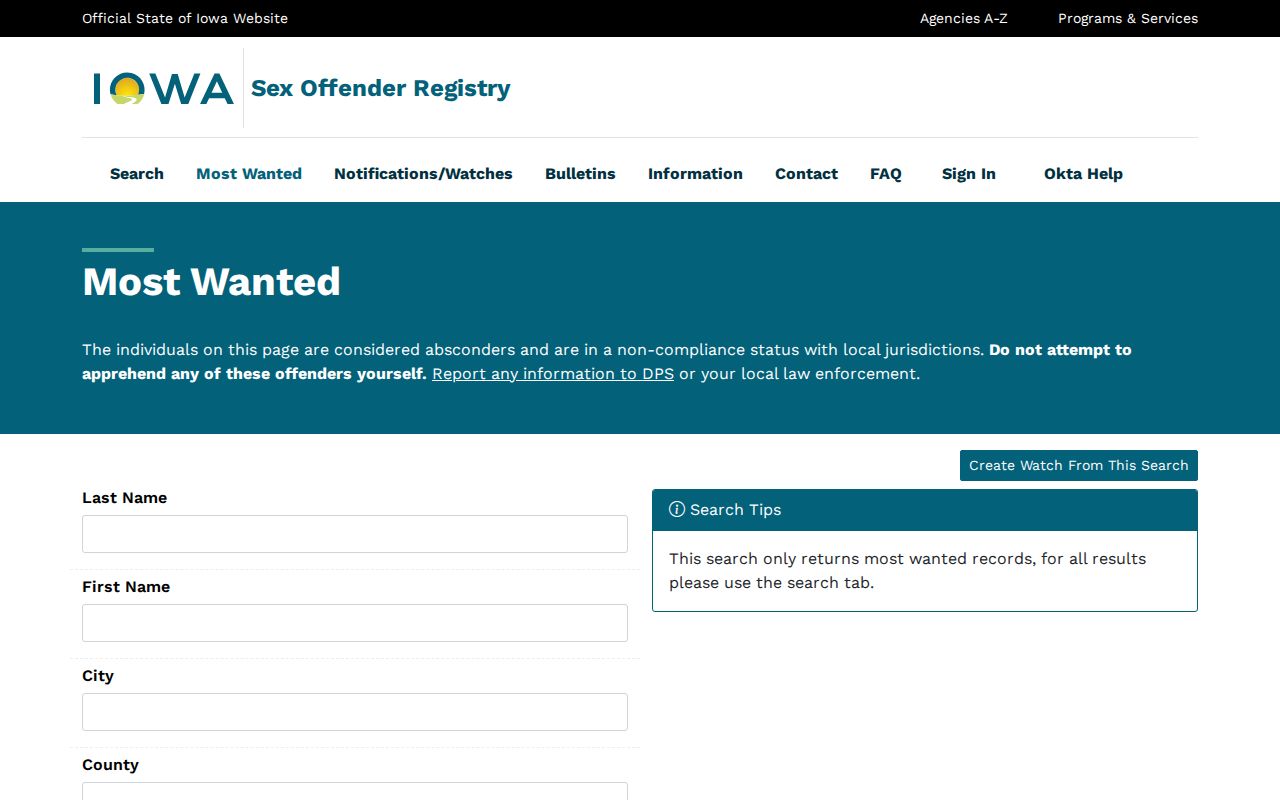
Use the state site's own controls and read its warning before searching. Results shift over time, so the live government page always outranks any saved screenshot.
Iowa County Warrant Tip Contacts
Iowa County has no verified anonymous tip form and no reward policy tied to a general wanted list. Do not count on either one. Report a sighting through Sheriff dispatch. For emergencies, call 911.
960 Franklyn Avenue
Marengo, IA 52301
Dispatch: 319-642-7307, staffed 24/7
Civil Office: 319-642-3496
Office: Monday through Friday, 8:30 a.m. to 4:30 p.m.
Stick to facts when you call: where and when you saw the person, a safe description, and which notice you were reading. Never trail someone to gather more detail. A tip gives officers a lead to work with.
Note: Since no county reward or anonymity promise is verified, ask dispatch directly how your information will be handled.
Check an Iowa County Warrant
No official public portal exists for searching Iowa County warrants by name. The statewide IOWA network links criminal justice agencies to wanted-person and related data, including NCIC. It serves agencies only, not the public. Steer clear of unofficial sites that hint at live access.
Worried about your own status? Talk to a lawyer or the court and arrange a lawful resolution. Advice on hiding, travel, or dodging service is unsafe and will not appear here.
- Call dispatch at 319-642-7307 and ask what can be verified by phone.
- Contact the Iowa County Clerk of Court for public case information.
- Search Iowa Courts Online, while remembering outstanding matters may be restricted until service.
- If the issue concerns the searcher, ask counsel or court about the correct appearance process.
- Recheck the docket so later filings and disposition guide any conclusion.
Iowa County Warrant Types
The exact warrant type and its instructions come from the court or the issuing agency. Broad labels help frame a question. They cannot tell you what a named person actually faces.
| Type | Why the source matters |
|---|---|
| Arrest warrant | Directs arrest tied to an alleged offense; access may be limited before service. |
| Bench warrant | May arise from a missed court duty; the clerk or counsel can explain next steps. |
| Search warrant | Authorizes a defined search, not a public wanted-person listing. |
| Registry notice | Covers a specialized compliance category, not every local warrant. |
A warrant is a court-issued command authorizing a stated act. The docket later shows service, recall, dismissal, plea, or another outcome.
No Iowa County Warrant App
No official Iowa County Sheriff app or social booking feed checks out. One caution: a similarly named app from Iowa County, Wisconsin is a different state entirely. Confirm the agency, address, and state before trusting any app.
Williamsburg Police points residents to Facebook and Nixle for releases and alerts. Those are hand-picked notices, not full arrest logs, and posts can be delayed, edited, or deleted. A missing post never clears a warrant.
VINE can alert you to custody changes, but it is not a warrant search or a photo feed. The chain stays simple: dispatch or court for warrants, the jail for custody, the docket for what happened next.
Iowa County Court Status After Service
What does a warrant check actually tell you? Very little beyond the present moment. The public docket opens up once service happens, and it can carry a lot: the complaint, the first appearance, attorney entries, later filings, charges, fines, payments, and the final disposition. Iowa County sits in Judicial District Six. When a new case refuses to surface online, or an old file needs eyes on it, the Clerk of Court is the local route.
Timing explains most gaps. Iowa Courts Online allows up to 14 days for a citation to appear, and a fresh case typically takes a business day to land in search results, though updates run in real time after that. So a dispatch call and a name search answer two different questions. Neither one should be stretched past its purpose.
Identity matching matters too. Begin with the name, then narrow by county and anything else you know, since similar names trip people up. A date-of-birth search demands an exact first name, last name, and birth date. Got a case number? Pair the county, case type, and full identifier. And read the latest charge and disposition entries rather than stopping at the case title.
Older trial cases may need clerk help, and pending matters can stay sealed until service. That restriction is not proof that no warrant exists. After resolution, keep the court outcome separate from any old booking image or wanted notice still floating around elsewhere.
Verify Iowa County Case Outcomes
Booking and prosecution are two different tracks. A booking record describes jail intake; the docket follows the case through court. Release does not dismiss a charge, and custody does not settle one. Court orders govern release, and the case record later shows how the matter ended. Keep every record tied to its own date and source so the lines stay clear.
Iowa County Custody Is Separate
Three questions, three answers. A wanted notice, a warrant's status, and jail custody each stand apart. A warrant can exist long before anyone is arrested, and once officers take a person into custody, Iowa County Jail creates the intake record and holds that person as the court directs until release is ordered. There's a catch, though. The county publishes no searchable roster or booking feed, so a blank web result proves nothing about who is free, booked, or never arrested.
Need an answer right now? Call the Jail Division at 319-642-7307, extension 2. Iowa VINE offers another official path when the person and the participating facility both appear there. VINE covers custody status and notifications, not wanted lists, mugshot feeds, or court outcomes. A transfer or release alert signals a custody change and nothing more.
Want a booking sheet or photograph? Make a focused Chapter 22 request to the Sheriff. Name the person, give an approximate arrest date, and specify the record sought. Ask for the booking record and the photo separately, since they are distinct items. The Sheriff decides what is held and what is releasable. And don't read a warrant into a booking photo, because arrests can flow from other processes too.
Iowa County Records Request Route
The Sheriff's Civil Office is the practical contact for records. Its phone line is 319-642-3496. Its email is civil@iowacosheriff.org. Regular hours run Monday through Friday, 8:30 a.m. to 4:30 p.m. With no online page to lean on, a request can fairly ask whether a warrant-related or booking record is public, though it should not demand access to the law-enforcement-only IOWA system.
Keep the description narrow. Give the name, the date range, the agency, and any known case or incident number. Ask the custodian to identify any withheld portion and the reason behind it. Some records stay out of reach because a matter is pending, restricted, or sitting with another office. Any response reflects its processing date; later service, a recall, or court action can shift the picture.
Trying to resolve your own warrant? Records correspondence is no substitute for legal advice or a court appearance. Reach out to counsel or the Clerk of Court instead. Follow the official directions for the case. Keep confirmation of every filing, appearance, or recall. That lawful path beats relying on an old post or a namesake's record every time.